
Author: A Solitary Pagan
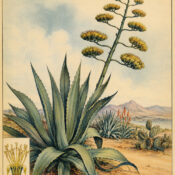

The Century Plant and Its Place in Paganism & Witchcraft
The Century Plant, commonly known as agave, is a striking succulent native to the arid regions of the Americas. Despite its name, it does not live for a century; most species flower after ten to thirty years before completing their life cycle. Its dramatic appearance, with thick, pointed leaves arranged in a rosette, has made it a symbol of endurance, protection, and transformation in many spiritu...


Celosia: A Sacred Flame in Paganism and Witchcraft
Celosia, often recognized by its vibrant, flame-like blooms, is a striking plant that has found a place in modern Pagan and witchcraft traditions. Its name derives from the Greek word kelos, meaning “burned” or “fiery,” a fitting description for its brilliant red, orange, pink, and gold flowers. Commonly known as cockscomb or woolflower, Celosia’s unique appearance ha...


Celandine and Its Place in Paganism and Witchcraft
Celandine is a bright and cheerful wildflower that has long held a place in folklore, pagan traditions, and witchcraft. The name “celandine” is commonly applied to two plants: Greater Celandine (Chelidonium majus) and Lesser Celandine (Ficaria verna). In magical practice, however, Lesser Celandine is often associated with springtime energy, renewal, and the return of the sun after winter. Blooming...


Cauliflower and Its Place in Paganism & Witchcraft
Cauliflower (Brassica oleracea var. botrytis) is a nutritious vegetable belonging to the cabbage family. Known for its dense white head, often called a “curd,” cauliflower has been cultivated for centuries and valued for both its culinary and medicinal properties. While it does not possess the extensive folklore associated with herbs such as sage, rosemary, or mugwort, cauliflower stil...
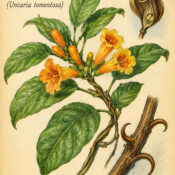

Cat’s Claw: A Sacred Vine in Paganism and Witchcraft
Cat’s Claw (Uncaria tomentosa) is a woody vine native to the Amazon rainforest and parts of Central and South America. Named for its distinctive curved thorns that resemble the claws of a cat, this remarkable plant has been valued for centuries by Indigenous peoples for its medicinal properties. Beyond its physical uses, Cat’s Claw has also found a place in modern Pagan and witchcraft traditions, ...
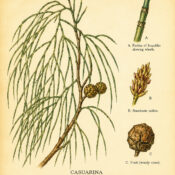

Casuarina and Its Place in Paganism & Witchcraft
The Casuarina, often called the “she-oak” or “Australian pine,” is an evergreen tree known for its slender, needle-like branchlets and distinctive whispering sound when stirred by the wind. Native to Australia, Southeast Asia, and parts of the Pacific, Casuarina has long been valued for its resilience, adaptability, and protective qualities. These characteristics have also ...
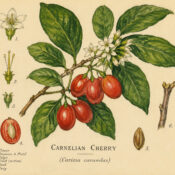

Carnelian Cherry: A Sacred Plant in Paganism and Witchcraft
The Carnelian Cherry (Cornus mas) is a small tree or large shrub native to parts of Europe and Western Asia. Known for its bright yellow blossoms that appear in late winter and its deep red, cherry-like fruits, this hardy plant has long been valued for both its practical uses and its symbolic significance. In various folk traditions, the Carnelian Cherry has become associated with themes of resili...


Carline Thistle: A Protective Plant in Paganism and Witchcraft
The Carline Thistle (Carlina vulgaris and related species) is a striking wild plant known for its spiny leaves and golden, star-like flower heads. Found throughout much of Europe, it has long been valued not only for its medicinal properties but also for its place in folklore, pagan traditions, and magical practice. In pre-Christian Europe, the Carline Thistle was regarded as a powerful protective...
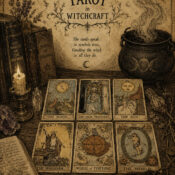

Tarot
Tarot has long held a significant place within modern Paganism and Witchcraft, serving as both a tool for divination and a means of spiritual exploration. Although tarot cards were originally developed in 15th-century Europe as playing cards, they gradually evolved into a system of symbolism and mystical interpretation. Today, many Pagans and witches use tarot to gain insight into personal challen...


Feathers and Their Place in Paganism & Witchcraft
Feathers have long held a special place in pagan and witchcraft traditions, symbolizing the connection between the earthly and spiritual realms. As gifts from birds—creatures that move freely between the sky and the land—feathers are often viewed as sacred objects that carry messages, energy, and wisdom from the natural world. In many pagan paths, feathers are associated with the element of Air. A...


Air Magick and Its Place in Paganism & Witchcraft
Air Magick is one of the foundational elemental practices found throughout many Pagan and Witchcraft traditions. Associated with the element of Air, this form of magick focuses on the powers of thought, communication, inspiration, wisdom, and movement. Air is often linked to the mind and intellect, making it an essential force for spells involving learning, creativity, truth, and spiritual awarene...


Crystals and Their Place in Paganism and Witchcraft
Crystals have held a significant place in spiritual traditions for thousands of years, and they remain an important part of many modern Pagan and Witchcraft practices. Valued for their beauty, rarity, and perceived energetic properties, crystals are often used as tools for meditation, healing, protection, and magical work. In Paganism, the natural world is regarded as sacred, and crystals are seen...