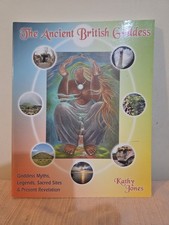
Kathy Jones’s The Ancient British Goddess is a fascinating and spiritually rich exploration of the feminine divine in the myths, landscapes, and sacred traditions of Britain. First published in the early 1990s and later expanded, the book combines mythology, folklore, archaeology, and contemporary spirituality to present a vision of an ancient Goddess tradition that Jones believes continues to resonate in the modern world.
One of the book’s greatest strengths is its ability to weave together stories from England, Scotland, Wales, and Ireland into a coherent narrative of the British Goddess. Jones introduces readers to a wide range of goddesses, legends, and sacred sites, encouraging them to see the landscape itself as a living expression of divine feminine power. Her descriptions of wells, hills, stone circles, and ancient shrines are vivid and evocative, making the book both an informative study and a spiritual journey.
The author writes with passion and conviction, drawing on archaeological theories, folklore, and the work of scholars such as Marija Gimbutas to argue that Goddess symbolism was deeply embedded in prehistoric Britain. She interprets ancient carvings, monuments, and natural features as evidence of a widespread reverence for the Goddess as creator, nurturer, and renewer of life.
However, readers should be aware that the book is written from a spiritual and devotional perspective rather than a strictly academic one. While Jones presents compelling interpretations, some of her conclusions remain debated among historians and archaeologists. Those seeking rigorous scholarly analysis may find certain arguments speculative, but readers interested in mythology, pagan spirituality, or Goddess traditions are likely to appreciate the imaginative and inspirational approach.
Ultimately, The Ancient British Goddess is a thought-provoking and beautifully written work that invites readers to reconnect with Britain’s sacred landscapes and feminine spiritual heritage. Its blend of myth, history, and spiritual insight makes it a valuable resource for anyone interested in Celtic traditions, Goddess spirituality, or the enduring power of myth in contemporary life. Even when one questions some of its historical claims, the book succeeds in inspiring wonder, reflection, and a deeper appreciation of the ancient stories woven into the British landscape.