Merlin is a legendary figure deeply rooted in British folklore, whose story blends myth, legend, and possible fragments of history. His earliest appearances can be traced to medieval Welsh poetry and chronicles, where he is depicted as a prophet, a wild man of the woods, and a master of arcane knowledge. Over centuries, his legend evolved, absorbing elements from Celtic, Roman, and Christian traditions.
According to tradition, Merlin’s mother was a mortal woman, while his father was often described as a supernatural being—sometimes a demon, sometimes a spirit. This mysterious parentage was believed to grant Merlin extraordinary magical powers from birth. Medieval writers, such as Geoffrey of Monmouth, described Merlin as a seer who could interpret dreams, foresee the future, and perform feats of magic that ordinary people could not even imagine.
Merlin’s abilities were said to be vast and varied. He was credited with shape-shifting, controlling the weather, and communicating with animals. Some tales recount his power to move great stones, summon mists, and even become invisible at will. He was also known for his wisdom in herbalism, healing, and the use of enchanted objects. These abilities made him a figure of awe and sometimes fear, as he seemed to bridge the worlds of the natural and the supernatural.
Merlin’s life is filled with both wonder and tragedy. He is best remembered as the wise advisor to kings, most notably King Arthur. Merlin’s guidance was crucial in Arthur’s rise to power, from orchestrating his conception to advising him on matters of state and war. In some stories, Merlin is responsible for the creation of the Round Table and the establishment of Arthur’s court at Camelot. His counsel was sought not only for his magical prowess but also for his deep understanding of human nature and destiny.
The influence of Merlin’s legend extends far beyond the Arthurian tales. He has become a symbol of the wise druid or shaman, a mediator between the physical and spiritual realms. In many interpretations, Merlin represents the transition from the old pagan beliefs of Britain to the emerging Christian worldview of the Middle Ages. His character embodies the tension and blending of these two traditions, often serving as a bridge between ancient wisdom and new faith.
There are also theories that Merlin was inspired by real historical figures. The Welsh prophet Myrddin Wyllt, also known as Myrddin Emrys, is sometimes identified as the basis for Merlin. Myrddin was said to have lived in the late 6th century, retreating into the forests of northern Britain after witnessing the devastation of war. There, he became known for his poetry, his prophecies, and his deep connection to the natural world. Some scholars suggest that stories of Myrddin merged with other local legends to create the composite figure of Merlin.
Over time, Merlin’s legend has been reinterpreted and expanded by countless writers, artists, and scholars. Geoffrey of Monmouth’s “Historia Regum Britanniae” was instrumental in popularizing Merlin in the 12th century, presenting him as both a prophet and a kingmaker. Later, Sir Thomas Malory’s “Le Morte d’Arthur” and Alfred Lord Tennyson’s “Idylls of the King” further shaped Merlin’s image in literature, emphasizing his role as a mentor and his tragic fate.
Merlin’s end is as mysterious as his life. In some tales, he is trapped by the enchantress Nimue or Vivien, sealed away in a cave or a magical prison. Other stories claim he sleeps in a hidden chamber on Bardsey Island, accompanied by nine companions, destined to return if Britain ever faces its greatest need. This motif of the sleeping hero echoes ancient myths and reinforces Merlin’s enduring presence in the collective imagination.
The cultural impact of Merlin is profound. He has inspired countless adaptations in literature, theater, film, and art. From medieval manuscripts to modern fantasy novels and movies, Merlin’s image continues to evolve, reflecting the changing values and beliefs of each era. He is often portrayed as a wise old man, a mysterious hermit, or a powerful magician, but always as a figure who challenges the boundaries of the possible.
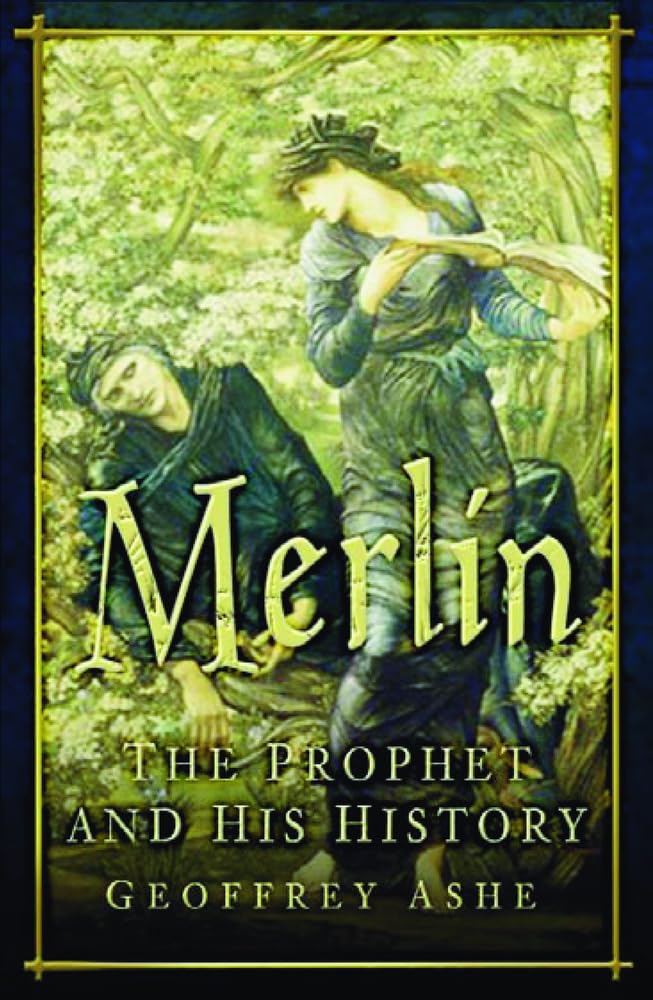
Scholars such as Geoffrey Ashe have explored Merlin’s possible historical roots, suggesting that behind the myths lies a real prophet or wise man who influenced the legends of Arthurian Britain. While the magical elements of his story may be symbolic, Merlin remains one of the most compelling and believable characters in the Arthurian cycle. His blend of wisdom, mystery, and humanity ensures his place as a central figure in Western myth and storytelling.
Ultimately, Merlin’s legend endures because it speaks to universal themes: the search for knowledge, the balance between power and wisdom, and the connection between the seen and unseen worlds. Whether viewed as a historical figure, a literary creation, or a symbol of transformation, Merlin continues to inspire both history and imagination, inviting each generation to explore the mysteries of the past and the possibilities of the future.