
Author: A Solitary Pagan
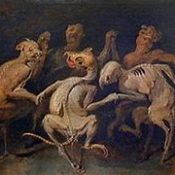

The burning alive of Father Louis Gaufridi
The burning alive of Father Louis Gaufridi for bewitchment of the nuns at Aix in 1611 formed the legal precedent for the conviction and execution of Urbain Grandier at Loudun more than 20 years later. This case was one of the first in France to produce a conviction based on the testimony of a possessed demoniac. Prior to the 17th century in France, accusations from a demoniac were considered unrel...
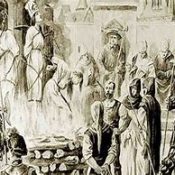

Gruber, Bernardo (17th century)
German trader accused of sorcery by Pueblo Indians in northern New Mexico. Bernardo Gruber was imprisoned. He escaped but died a strange death. In 1668, Gruber arrived in New Mexico with a pack train of mules bearing fine goods. It was said that he was fearless and traveled through the lands of the fierce Apache without harm. Perhaps it was his ability to avoid Apache attacks that led to his downf...
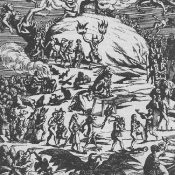

Arras witches (1459–1460)
A mass witch hunt in Arras, northern France. The accused were brutally tortured and promised their lives, then burned at the stake. The incident roused the ire of the duke of Burgundy, and eventually those executed were posthumously exonerated. The witch hunt was one of the earliest in the region. Inquisitors used charges of witchcraft against heretics such as the Waldenses, or Vaudois, a religiou...

Ladder
Widely held superstitions that it is bad luck to walk beneath a ladder are related in part to fears about witches, especially during the witch hunt times in colonial America. Not all witches were burned—for example, in England and in the American colonies, witches were hung. When they dropped, they fell below the ladder leading up to the gallows. It was believed that if a witch touched anyone stan...

Chelmsford Witches
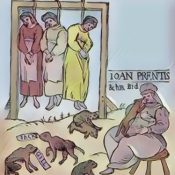
Chelmsford witches Four major witch trails in the 16th–17th centuries that resulted in numerous convictions and executions. The first trial occurred in the summer of 1566, under the rule of Queen Elizabeth, whose Parliament had passed the second of England’s three witchcraft acts in 1563. The Act of 1563 tightened penalties for witchcraft, making it a felony to invoke evil spirits for any purpose,...

Corey Giles (d 1692)
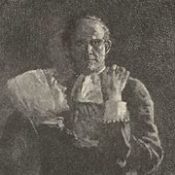
Executed in the Salem Witches hysteria of 1692–93 by being pressed to death for not acknowledging the right of the court to try him on charges of witchcraft. Giles Corey was a well-to-do man of Salem Town, in his 80s when the hysteria started. He owned a farm of 100 acres and other properties as well. Though hardworking, he was not entirely well regarded, having a reputation for being quarrelsome ...

Butters, Mary (late 18th–early 19th centuries)
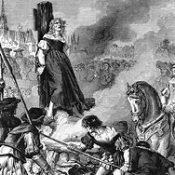
An attempt to cure a cow of bewitchment with white magic ended in disaster for Mary Butters, the “Carmoney Witch,” who narrowly escaped a trial in Carrickfergus, Ireland, in March 1808. Butters was a reputed wise woman, skilled in herbal knowledge and various spells. In August 1807 Butters was hired by Alexander Montgomery, a tailor who lived in Carmoney, to cure a cow that gave milk from which no...

Corey, Martha (d. 1692)
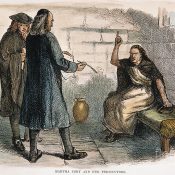
The fourth person to be accused of witchcraft in the Salem Witches hysteria of 1692–93, who was tried and executed. Martha Corey was the wife of Giles Corey, who also was executed. The Coreys were well-to-do, pious residents of Salem Town. Martha’s age at the time of the trials is not known. Presumably, she was beyond child-bearing years. She was Giles’ third wife; the couple had no children of th...
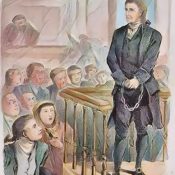

Burroughs George (d. 1692)
Burroughs, George (d. 1692) Minister accused of witchcraft and executed in the Salem Witches hysteria in Massachusetts in 1692 to 1693. George Burroughs served as minister of Salem Village from 1680 to 1682. He was a man of good reputation, having graduated from Harvard in 1670. He had distinguished himself as a preacher in Maine, especially in the face of hostilities from Indians. Invited to Sale...
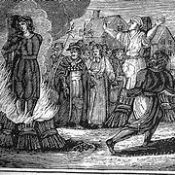

Gowdie, Isobel:1662
Scottish witch whose stories of wild sexual escapades with the Devil titillated and shocked her stern neighbors and reinforced the prevailing beliefs in witches as evil creatures bent on destroying their fellow man. Isobel Gowdie, an attractive woman with red hair, a color associated with witches, voluntarily confessed to witchcraft on four occasions in April and May 1662. The confessions in thems...
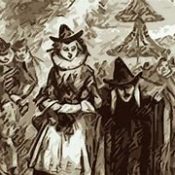

Cole, Ann (17th century)
Accused witch in Hartford,Connecticut, who was believed to be under demonic possession. The case was recorded in a letter written by Reverend John Whiting, which in turn was published by Increase Mather in An Essay for the Recording of IllustriousProvidences (1684). Ann Cole was described by Mather as a woman of great integrity and piety. In 1662, she was living in the house of her father—“a godly...
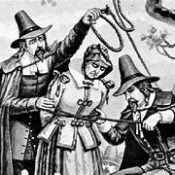

Greensmith, Rebecca (17th century)
Hartford, Connecticut, woman accused of witchcraft, who confessed and was executed. Rebecca Greensmith and her third husband, Nathaniel, lived next door to Ann Cole. The couple was reasonably affluent, but Rebecca was considered a “lewd and ignorant” woman. In 1662, when Cole was brought up on charges of witchcraft, Greensmith was already languishing in prison on charges of witchcraft, which she d...