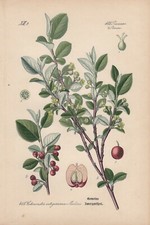
Dwarf mistletoe (Arceuthobium species) is a small parasitic plant that grows on conifer trees such as pines, firs, and spruces. Unlike the familiar Christmas mistletoe with its green leaves and white berries, dwarf mistletoe is much smaller, often appearing as clusters of yellow, orange, or green stems protruding from tree branches. It absorbs water and nutrients directly from its host tree, sometimes weakening or deforming it over many years. Found throughout North America, Europe, and parts of Asia, dwarf mistletoe plays an important ecological role by creating habitats for birds, insects, and other wildlife, even though foresters often consider it a pest because it can damage commercial forests.
In paganism and witchcraft, mistletoe of all kinds has long been associated with mystery, endurance, and the hidden forces of nature. While historical references usually describe European mistletoe rather than dwarf mistletoe specifically, modern practitioners often extend similar symbolic meanings to this smaller relative. Growing high among tree branches without rooting in the earth, mistletoe represents the connection between the heavens and the natural world, making it a symbol of spiritual balance and transformation.
Many modern pagans see dwarf mistletoe as a reminder that strength can exist in unexpected places. Despite its tiny size, it survives in harsh environments and persists through changing seasons. Because of this resilience, it is sometimes used symbolically in spells or rituals focused on perseverance, adaptability, and overcoming obstacles.
Some witches also associate dwarf mistletoe with protection, insight, and liminal spaces—places or moments that exist between one state and another. Its unusual lifestyle, living between life and dependence, gives it an aura of mystery that suits magical work involving transitions, hidden knowledge, or personal growth. As with any wild plant, practitioners are encouraged to harvest responsibly and respect local ecosystems, or simply use photographs, drawings, or symbolic representations in their rituals.
Although dwarf mistletoe lacks the fame of its larger cousin, it remains a fascinating plant whose unusual biology and symbolic associations continue to inspire those interested in nature-based spirituality, folklore, and modern magical traditions.