
Author: A Solitary Pagan


A Spring Equinox Cleaning Ritual
Use this ritual to welcome the winds of positive change You can perform it on any of the three days of the rising equinox energies that precede the equinox. Alternatively, it can be adapted for cleansing away negativity and sorrows at any time. I give an alternative version in my book Psychic Protection Lifts the Spirit. You can join with family or friends in a communal spring cleaning of a collec...


Ritual and Spellwork
It might be said that Witchcraft, recognizes the laws of the Universe symbolically through the Goddess and God, the Wheel of the Year, and reverence for all living things. Rituals performed in celebration of these aspects of the Universe may or may not involve magical work, as some Witches prefer to focus on what they view as the “spiritual” side of life. Witches, on the other hand, tend to blend ...


Rituals in Magick
Ritual magick is no different from any other activity that you may carry out in a systematic way. Yes, it is true, it is more formal than folk magick: you are using special tools and following a series of preordained steps based on traditional practice. But this does not mean that it has to be so complicated as to be beyond the capabilities of any normal person. You do not need special powers; and...


Rite of Wind
Light incense. Pass over working area. Place the representation of your magick key near your other supplies for this night. Close your eyes, and envision yourself surrounded by white light. Take thirteen slow, even breaths, inhaling through the nose and exhaling through the mouth. When you feel relaxed, open your eyes, and repeat today’s affirmation three times. Loosely grind a small amount (...


Samhain Rites and Rituals for a Hedgewitch
As this is the time when the veils between the worlds are thin, the Hedge Druid’s Craft concerns working with the ancestors and the Fair Folk at this time of the year. She can travel to the Lower world to contact her ancestral spirit guide or her fey spirit guide in order to glean information on the work that she should strive towards in the coming year. As Samhain marks the end of the old year an...


Rite of Celestial Power
Places your calendar on the center of the altar, along with your magickal key. Ring your bell or chimes eleven times. If you can, go outside and light your favorite incense. If you are confined inside, try to position yourself near a window with a good view of the heavens. Stand looking up at the heavens, and say: Celestial magick, speak to me Of sun and moon and heaven’s sea Of signs and li...


Rite of the Mountain
Light incense. On a purple candle, inscribe the word mountain with a pin, nail, or clay inscribing tool. Place the candle in a safe holder, and light. Intone the following mountain charm: Herbal magick, speak to me Of mountain’s sacred journey Of strength and will along the way Of choosing carefully what I say. Treasures lie inside me Tonight I grasp my own true wealth And give to earth that magic...

Rite of Stone
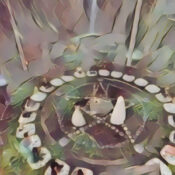
Arrange your thirteen chosen gemstones around your dedication candle. You will not light your dedication candle tonight; instead, we are preparing your altar for the final ceremony. Put your magick key beside your dedication candle. Light the incense and pass it over all the items on your altar. On a white candle (not the dedication candle), inscribe the word stone with a pin, nail, or clay inscri...


Rite of Thunder
Arrange the white candle, the bowl of aromatic herbs, and your magick key on your altar near the black and white plate project from last night. This particular rite is mostly mental, so relax and take several deep breaths before beginning. Prepare the thunder sound effects you will use shortly. Check the closet light to be sure the batteries are working properly. We will start with the light turne...


The Hedge Craft – Rites and Rituals
We previously looked at the word, enchantment (en chantement, “to singinto”) as that which brings the songs of magic and the universe togetherso there is a flow, balance and harmony as well as a guiding, directiveforce. We can use enchantment in our lives for the same reason, to reenchant our daily lives with the magical and the mystical, through theuse of prayers and chants for mundane tasks, sea...
Rite of Silence
This ritual is dedicated to pampering yourself, which means you won’t be working at your altar. You may visit a gym or a spa, or take a long, luxurious bath followed by a personal hygiene regime. You might decide to have your hair styled in a new way, shave off a beard, or color your hair in a new shade. Visit a nail salon or have fun shopping for new makeup or personal-care products. Choose a dar...


Summer Solstice Rites and Rituals for a Hedgewitch
The time of the greatest light, this is a good time of the year to harness the energy towards your goals. Riding the tide, we can stand in the heat of the noon-day sun and allow its energy to flow through us, empowering our bodies, souls and our work. We might use herbs traditional to this time of year, such as St John’s Wort, to further boost our work. Know, though, that after this special time w...