
Author: A Solitary Pagan
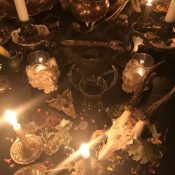

Magick: The Basis of Power
The basis of magic is power. Though magicians have used it for thousands of years, we still don’t know exactly what “power” is. But we do know how to work with it. Magic is the movement of natural but subtle energies to manifest needed change. These energies exist within ourselves, within our world, and within all-natural objects in it. These energies, whether in avocados or in our own bodies, sha...
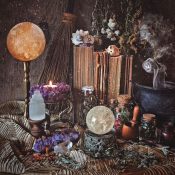

Witchcraft Theory & Practice – The center
The center has been called spirit, essence, soul, consciousness. It is the deep you that seeks to know and understand not only who you are, but why you are here. It is the whole of you as opposed to the sum of your parts, it is the gateway to all knowledge, and it is why this book has called to vou-like attracts like! You are aware that you have five senses: taste, touch, smell, hearing, and sight...
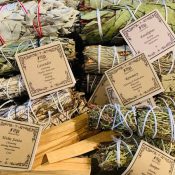

Smudging Herbs and their Properties
Smudging Herbs will drive out negative energies, spirits and influences. Use this as a smudge to purify people and places before any sacred ceremony. There are many varieties of sage, and most have been used in smudging. White Sage This sage is used just like desert sage, but many people prefer White Sage because of the sweeter aroma it gives off. Cedar This plant can also be used to purify, espec...

Spiritual Forgiveness
It could be an idea, that for those who are at the beginning of a spiritual path, the first step is not to attempt to be of service to others. It may be better, to first take the steps, to know and love the self. To come into communion with the self, so that one becomes to oneself, the individual that others are to themselves. It is often the self which criticizes the self the most harshly. ...


The Basics of HedgeWitchery
When beginning your journey in witchcraft, it is helpful to first connect with what you consider to be Spirit, or the force that guides the universe. This concept may be known by many names, such as the source, God, Goddess, or other terms from various traditions and pantheons. The specific name or details are less important than your personal sense of connection to something greater than yourself...
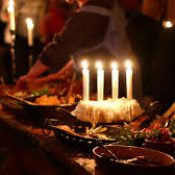

Kitchen Witch: Yule
Yule—the winter solstice—is an old solar ritual that has been preserved in the Christian observance of Christmas. Its origins lie deep in the past, in the Mediterranean lands of the sun. The birthday of Mithras, an ancient solar deity, was celebrated on the winter solstice. Later, this holiday was brought to Europe, and an astonishing collection of folk rituals became associated with it. Yule occu...
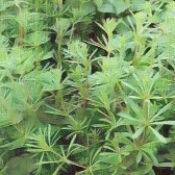

CLEAVERS
Cleavers, or Galium aparine, is a plant that weaves itself into the very fabric of folklore, herbalism, and magic. Its slender, square stems—bristling with tiny hooked hairs—cling to everything they touch, earning it a host of folk names: “sticky willy,” “goosegrass,” and “catchweed.” In the wild, you’ll find cleavers sprawling across hedgerows, woodland edges, and meadows, its narrow, lance-shape...
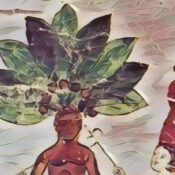

Plants and Mythology
The magical plant or herb of immortality sought by Gilgamesh, the hero of ancient Mesopotamian mythology, provides one example of how myths use plants as symbols of life and of the healing power of nature. However, because some plants yield poisons and some die in winter, plants can also represent death and decay. Various trees, shrubs, herbs, grains, flowers, and fruit appear in myths and legends...
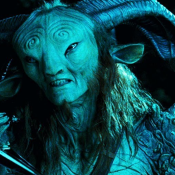

The Labyrinth
In Greek mythology, the Labyrinth is one of the most famous and symbolic structures. The word “Labyrinth” (Greek: labyrinthos) means a complicated maze. The most well-known Labyrinth was built on the island of Crete. According to legend, King Minos of Crete asked the skilled craftsman Daedalus to design and build this complex maze at his palace in Knossos. The main purpose of the Labyrinth was to ...