
Author: A Solitary Pagan
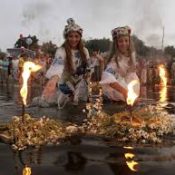

Kupalnocka, or the Slavic Valentine’s Day
“Kupała Day was the longest of the year, Kupała Night the shortest – it was one ceaseless passage of joy, song, leaping, and rites,” Józef Ignacy Kraszewski wrote in his Stara baśń (Old Tale). But for the Slavs, just one night of feasting was definitely not enough. The celebrations started on the day preceding the Summer Solstice (June 20th) and lasted for four days. It was first and f...
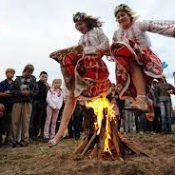

The Slavic holiday calendar
The Slavic holiday calendar began on 21st December, with a symbolic victory of light over darkness (the Winter Solstice). The Święto Godowe (Nuptial Holidays), also known as Zimowy Staniasłońc would end on 6th January, and it would pass by filled with song. The joy of increasingly long and warm days was celebrated with songs called kolędy (the Polish equivalent of carols). Good luck was thought to...
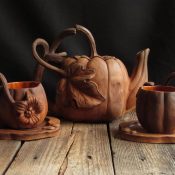

An Offering Plate for the Ancestors
At Samhain, we invite our ancestors to share our feast with us and, naturally, we want the table to look nice for them. Just as we put out the “good china” when we invite the living to reunion dinners, we like to make a special place at the altar and our feast tables even for those who are attending only in spirit. The simplest and least expensive way of making a special plate to hold the ancestor...
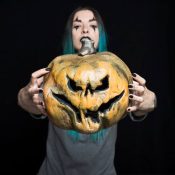

The Samhain Vow
In the old days and still for some, one of Winter’s vital tasks was to mend Summer’s tools—to mend the fishing nets, repair the hoe and shovel handles, and so on. Today, most of us don’t have that sort of work to do, but we all have inner work of equal importance to do. Perhaps there’s anger that needs healing so that a relationship can be restored. Perhaps there are prejudices that need education...

A Samhain Rite of Transformation Part 2
A solitary declares, or the coven’s Priestess and Priest share, the explanation of Samhain: This is the moment when the God’s grave becomes a womb, when He is no longer dead, but gestating. Now we no longer mourn His harvest death, but anticipate His rebirth at Yule. The Goddess still holds Him in the Earth that is Her body, and though Her body is chilled with Winter, the spark that is His life pr...

A Samhain Rite of Transformation Part 1
A theme that unites Samhain’s aspects—harvest, reunion, and New Year’s—is transformation. This theme is so strongly at the core of this holiday that it has survived even into the secular celebration: for most non-Pagans, dressing up in costume is what defines Halloween. This ritual highlights Samhain’s power of transformation. For this ritual, you need very little. If you are casting a formal...

Honoring the Ancestors through Song
The term “ancestors” can be interpreted broadly. It may refer to family members who have passed away, such as grandparents, parents, aunts, and uncles. It can also include siblings, friends, and even companion animals. Additionally, “ancestors” may encompass influential individuals who have shaped your life, regardless of blood relation—such as public figures, mentors, or friends’ loved ones. The ...

Blessing and Consecration for Found Bones or Other Natural Material
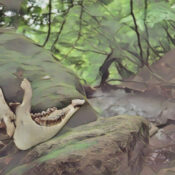
For this rite, you need salt and water, burning incense, a candle, and a clean white cloth. The incense should be woodsy-smelling, and the candle should be red or orange (colors of life) or black (for reunion with the Mother in the tomb/womb), as you see fit; the cloth can be an altar cloth or a towel, if that’s more appropriate. You can lay the cloth on your altar, on another table, or on the flo...
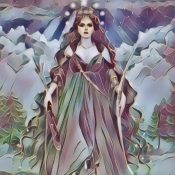

Hecate
For many Witches, Hecate is the goddess most associated with Samhain. (The pronunciation of her name varies. Some say Hehkah-tay, some say Heck-a-tay, and a very few say Heck-ate. Most of the Wiccans I know say Heck-a-tay.) She’s not a Celtic goddess at all; she’s Greek, and pre-Olympian, but the Romans knew her, and introduced the Celts to her when the Caesars’s empire extended through Western Eu...
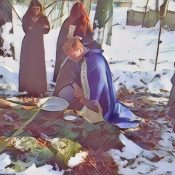

Sacred Slaughter
Today, the animals we eat are butchered with no ceremony at all; but for Neo-Pagans, slaughter is sacred. When, in Teutonic Magic, Kveldulf Gundarsson talks about the central act of a blot (the word rhymes with “boat,” literally translates as “blessing” and is what the Asatru call their ritual gatherings) as being “the sacrifice of one or more animals.” He explains that the sacrifice was “performe...
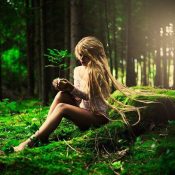

Calling the Dryads
As you become more proficient at using energies, you will find a need to link with nature spirits and spirits of the elements. These energies are very subtle and the incantations used in this spell acknowledge that subtlety. You will need: • BIRTHDAY CAKE CANDLES OF DIFFERENT COLOURS • ICE CREAM STICKS OR NUTSHELLS SUCH AS WALNUTS • WATER IN A NATURAL POOL, POND OR BOWL Method: Use different colou...
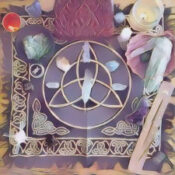

Setting up your altar
Setting up your altar is an important and personal part of starting your witchcraft journey. An altar is a special place where you focus your spiritual work and rituals. To create your altar, you will need a few basic items, each with its own meaning and use. Begin with candles. Traditionally, two candles are placed on the altar, each in its own holder. One candle often represents the female princ...