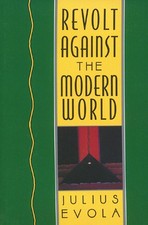
Revolt Against the Modern World by Julius Evola is one of the most controversial and intellectually challenging works of twentieth-century political and spiritual philosophy. First published in 1934, the book presents a sweeping critique of modern civilization and argues that humanity has declined from a sacred, hierarchical, and spiritually centered order into an age dominated by materialism, democracy, and moral decay.
Evola divides history into two opposing worlds: the “traditional” world and the modern world. According to him, ancient civilizations were built upon transcendent values, spiritual authority, discipline, and aristocratic ideals. In contrast, modern society is characterized by individualism, egalitarianism, consumerism, and the loss of higher meaning. Drawing from Hinduism, Buddhism, Roman traditions, medieval Christianity, and various mythological systems, Evola attempts to construct a universal philosophy of Tradition that transcends ordinary politics.
One of the book’s greatest strengths is its intellectual ambition. Evola writes with remarkable confidence and breadth, connecting religion, metaphysics, history, and culture into a unified worldview. His prose is dense yet powerful, and readers interested in philosophy, comparative religion, or critiques of modernity may find the work deeply stimulating. The book challenges many assumptions of contemporary liberal society and forces readers to confront difficult questions about spirituality, authority, and civilization.
However, the work is also deeply problematic. Evola’s rejection of democracy and egalitarianism, along with his admiration for aristocratic and authoritarian systems, has led many critics to associate his ideas with fascism and extremist political movements. Some arguments appear elitist, romanticized, and historically selective. His sweeping condemnation of modern values can feel exaggerated and disconnected from the practical benefits of modern democratic societies.
Despite these criticisms, Revolt Against the Modern World remains an influential and provocative text. It is not an easy book, nor a universally acceptable one, but it continues to attract readers because of its bold critique of modern civilization and its search for transcendent meaning in a rapidly secular world.