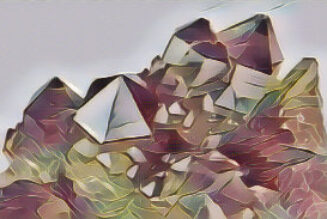
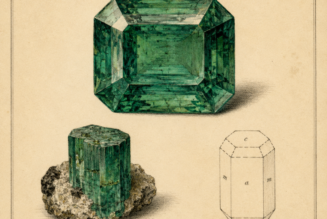
Rutile is an intriguing mineral, scientifically classified as a Titanium Oxide with the chemical formula TiO₂. It is most easily recognized by its slender, needle-like crystals, which often radiate outward from a central point, creating a distinctive sunburst or starburst pattern. These golden Rutile crystals frequently grow from clusters of shiny, flat metallic Hematite, resulting in mineral specimens that are both visually striking and highly sought after by collectors and geologists alike.
One of Rutile’s most fascinating features is its tendency to form what is known as twinning. In this process, individual Rutile crystals grow in a cyclic pattern, typically forming six to eight “twins” arranged in a circle. This unique growth habit can produce what is called a Rutile Star, where six Rutile crystals radiate symmetrically from a Hematite core. The orientation of these crystals is determined by the six rhombic faces of the Hematite, resulting in a geometric and aesthetically pleasing structure. Such formations are not only admired for their beauty but are also studied for the insights they provide into mineral growth and crystallography.
Rutile typically forms in high-temperature and high-pressure environments, such as those found in igneous and metamorphic rocks. It is commonly found in granite, gneiss, schist, and eclogite, and can also occur in sedimentary deposits as a resistant heavy mineral. Rutile is often discovered as inclusions within other minerals, most famously in quartz. When Rutile needles are trapped inside quartz, they create the shimmering, golden threads seen in rutilated quartz—a gemstone prized for its unique appearance and metaphysical properties. Rutilated quartz is used in jewelry and is believed by some to enhance the energetic qualities of both minerals.
The scientific significance of Rutile extends beyond its beauty. Rutile is a major ore of titanium, an element that is lightweight, strong, and highly resistant to corrosion. Titanium extracted from Rutile is used in a wide range of industrial applications, including the production of pigments for paints and plastics, the manufacture of aerospace components, medical implants, and even sports equipment. The pigment titanium dioxide, derived from Rutile, is valued for its brightness and opacity, making it a key ingredient in white paints and sunscreens. The industrial demand for Rutile has led to extensive mining operations in countries such as Australia, South Africa, and Ukraine.
In the realm of witchcraft and metaphysical practices, Rutile is cherished for its energetic and spiritual qualities. Many practitioners believe that Rutile can amplify intention, support spiritual growth, and facilitate connections to higher realms of consciousness. The golden rays of Rutile are often associated with clarity, illumination, and the strengthening of the aura. In ritual work, Rutile is sometimes used to enhance manifestation practices, aid in meditation, or clear energetic blockages. For example, placing a piece of Rutile or rutilated quartz on the third eye during meditation is thought to promote insight and mental clarity.
Rutile’s metaphysical associations are further enriched by its connection to the element of fire and the sun. Its radiant appearance is seen as a symbol of light, transformation, and personal power. Some traditions use Rutile to help dispel negative energies or to act as a protective talisman. It is also believed to stimulate creativity and inspire new ideas, making it a popular choice for artists, writers, and anyone seeking to unlock their creative potential.
Historically, Rutile has been admired for centuries, though its scientific identification as a titanium oxide came in the early 19th century. Its name is derived from the Latin word “rutilus,” meaning “reddish,” a reference to the mineral’s typical reddish-brown to golden color. Rutile’s unique optical properties, such as its high refractive index and strong dispersion, have made it valuable in the production of synthetic gemstones and as a component in optical instruments.
Whether appreciated for its scientific properties, industrial uses, or mystical significance, Rutile serves as a unique bridge between the worlds of science and spirituality. Its presence in both natural and metaphysical contexts highlights the interconnectedness of the material and the mystical. For collectors, practitioners, and scientists alike, Rutile remains a mineral of enduring fascination and multifaceted value.