Belief in the astral plane is a longstanding part of occult philosophy, shared by both witches and ceremonial magicians.
The term ‘astral’ comes from the Latin word Astrum, meaning star.
Medieval occultists used this word to describe a super-physical medium. They believed it was through this medium that the influence of the stars and planets reached the earth and affected everything on it.
In simple terms, the astral plane is considered part of a super-physical world. This world is made up of a finer essence, or energy that vibrates at a higher rate than the physical world.
This does not mean the astral plane is literally above us, like a heaven.
Instead, everything in the physical world is thought to be surrounded and permeated by its astral counterpart.
Occultists often describe the universe as a scale of vibrations. Our physical world is just one level—the one our senses can detect.
Many people are familiar with the idea of the astral plane thanks to nineteenth-century Theosophical writers like Madame Blavatsky, and books on modern Spiritualism. However, it is important to note that this concept is much older and has deep roots in magical traditions.
For example, Francis Barrett’s book The Magus, published in 1801 and considered a classic of ceremonial magic, describes the astral plane as a fundamental idea in magical practice.
Eliphas Levi, another influential nineteenth-century magician, also wrote extensively about this concept, referring to it as ‘the Astral Light’.
A key belief among occultists is that the substance of the astral plane responds to thoughts and emotions.
Because of this, the astral body—sometimes called the double, doppelganger, or ‘fetch’—is known in Hindu philosophy as the Kama Rupa, or ‘desire body’.
Interestingly, ancient occult philosophers from different continents and eras have shared similar ideas and beliefs about the astral plane.
For instance, the Ancient Egyptians believed in the human double, which they called the Ka. Old Norse legends mention the Scin Laeca, or ‘shining body’, described as a human figure surrounded by ghostly light.
If these beliefs were simply imaginary, it is curious that such similar ideas appear across different cultures and times.
The astral body is thought to allow a person to function on the astral plane, and it is believed to survive after the death of the physical body.
However, it is also believed that people can visit the astral plane and experience visions in the astral light while still alive.
Developing the ability to travel clairvoyantly in this way is one of the goals pursued by witches.
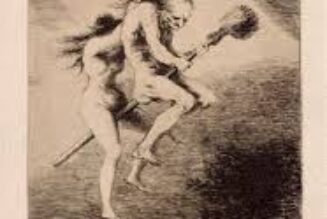
This idea is the origin of the stories about witches flying through the air.
According to these beliefs, the flying witch is traveling in her astral, not physical, form.
This understanding was recognized as early as 1647 by Henry More.
More was a Platonist and a student of occult philosophy.
In his poems, published in 1647 (and later by the University of Manchester in 1931 and AMS Press, New York, in 1878), when witchcraft was still a capital offense in Britain, he wrote a significant passage:
“And ’tis an art well known to Wizards old And wily Hags, who oft for fear and shame Of the coarse halter, do themselves withhold From bodily assisting their night game.
Wherefore their carcasses do home retain, But with their souls at these bad feasts they are, And see their friends and call them by their name, And dance about the Goat, and sing har, bar, And kiss the Devil’s breach, and taste his deadly cheer.”
Although More, as a Christian, viewed the witches’ Sabbat as diabolical, his studies in occult philosophy led him to see the truth behind these stories: astral projection is one of the secrets of witchcraft.
This belief also explains the old idea that a witch or wizard casts no shadow.
If someone saw them in their astral form, the double would not cast a shadow, since it is not made of physical matter. The Church’s strong opposition to psychic powers created fear and superstition, so anyone believed to be able to project their astral body was often labeled a witch.