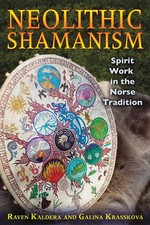
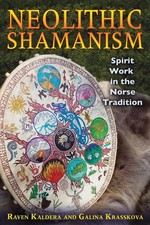
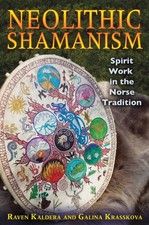
Neolithic Shamanism: Spirit Work in the Norse Tradition, written by Raven Kaldera and Galina Krasskova, is an intriguing and practical exploration of spirit-centered practice rooted in the authors’ reconstruction of ancient Northern European traditions. Rather than presenting a purely historical study, the book serves as a hands-on guide for readers interested in developing relationships with the spiritual forces of nature, ancestors, and the elemental powers associated with the Norse worldview. The authors provide numerous exercises and rituals designed to help practitioners engage directly with these forces, making the book both instructional and experiential.
One of the book’s greatest strengths is its accessibility. Kaldera and Krasskova write in a straightforward, engaging style that welcomes newcomers while still offering valuable insights for experienced practitioners. The text is organized around different aspects of the natural and spiritual world—including Earth, Sun, Moon, Plants, Animals, Water, Fire, Air, and Ancestors—allowing readers to explore specific areas of interest at their own pace. The inclusion of more than eighty practical exercises transforms the work from a theoretical discussion into a genuine workbook for spiritual development.
Another notable feature is the authors’ emphasis on commitment, responsibility, and respect in spirit work. Unlike many contemporary spiritual manuals that focus primarily on personal empowerment, this book highlights the challenges, risks, and obligations involved in building relationships with spiritual beings. This realistic approach lends credibility and depth to the material.
However, the book is not without limitations. Readers seeking a rigorous academic treatment of Norse religion or archaeology may find the title somewhat misleading. Much of the material is based on modern reconstruction and personal spiritual experience rather than historical certainty. The authors openly acknowledge this, but some readers may question the distinction between historical tradition and contemporary interpretation.
Overall, Neolithic Shamanism is a thought-provoking and practical guide that offers a unique perspective on modern Norse-inspired spirituality. While it should not be mistaken for a scholarly history of ancient Scandinavian religion, it succeeds admirably as a manual for those interested in spirit work, animism, and experiential pagan practice. I would rate it 4 out of 5 stars for its originality, practicality, and engaging presentation.